
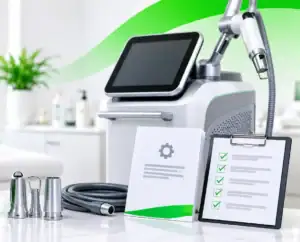
 Found the same laser model listed at two very different prices? Make sure both sellers are offering the same treatment setup before deciding which one costs less
A used aesthetic laser may power on and still be missing the handpiece, scanner, cooling system, software, or accessories required for the treatments behind the purchase. The lower price can disappear quickly once those components, repairs, and setup costs are added.
The paperwork deserves the same attention. The purchase should clearly identify the exact system, what comes with it, how it was evaluated, what coverage applies, and who is responsible if something arrives damaged or incomplete.
This guide will help you compare the full equipment package, calculate the treatment-ready cost, and avoid paying for a console that cannot support the services you planned to add.
Start With the Exact System Being Sold
A product brochure explains what a platform can support. It does not confirm what comes with the individual system listed for sale.
Two lasers with the same model and year may have different:
- Wavelengths
- Handpieces
- Applicators
- Filters
- Scanners
- Spot sizes
- Cooling systems
- Software options
- Treatment modes
- Accessories
Ask for a written equipment list tied to the specific serial number. It should clearly separate:
- Components included in the purchase
- Items shown in photos but sold separately
- Optional handpieces that are not included
- Parts that still need service
- Consumables required before treatment
- Manufacturer programs or benefits that may not transfer
That list should match the invoice, purchase agreement, and final packing list.
What Should Come With the Main System?
The console is the center of the equipment package, but it is rarely the only thing required to begin treatments.
| Equipment | What to Confirm | Why It Matters |
|---|---|---|
| System base | Manufacturer, model, year, serial number, software, and enabled options | Confirms the exact unit being purchased |
| Power components | Correct cord, plug, voltage, and electrical requirements | Prevents installation delays |
| Operating controls | Foot pedal, keys, emergency controls, and removable switches | Missing controls may prevent operation |
| Delivery system | Fiber, articulated arm, scanner, cable, or applicator connection | Carries energy from the base to the treatment area |
| Cooling system | Contact cooling, cryogen, chilled air, water cooling, or vacuum components | May be required for safe and consistent treatment delivery |
| Protective eyewear | Eyewear appropriate for the included wavelengths | Supports the required laser-safety setup |
| Packing and crating | How the system and attachments will be secured | Helps protect equipment during transport |
A listing described as a “complete system” should explain exactly what complete means for that model and configuration.
Handpieces Determine What the Laser Can Actually Treat
Handpieces are not minor accessories. On many platforms, they determine the wavelength, spot size, treatment depth, cooling method, speed, or service category available from the system.
The Lumenis LightSheer DUET shows how much the attachment can change the workflow. Its ET handpiece uses a 9 × 9 mm spot with ChillTip contact cooling for smaller areas, while the HS handpiece uses a 22 × 35 mm spot with vacuum assistance for faster coverage of larger areas.
A DUET sold with one handpiece does not provide the same treatment flexibility as a system that includes both.
Tattoo-removal platforms create another example. The Candela PicoWay may use different wavelength applicators for different ink colors and skin-focused treatments. A working PicoWay base without the required wavelength attachment may not support the treatment that justified the purchase.
For every included handpiece, confirm:
- Exact model or part number
- Wavelength
- Available spot sizes
- Supported treatment applications
- Cooling or vacuum method
- Connector and cable condition
- Recognition by the console
- Usage data when available
- Testing completed
- Known service needs
Build the treatment menu around the handpieces included with the individual unit, not every attachment the wider platform family can support.
Check the Smaller Components Before They Create Bigger Costs
A missing distance gauge or filter may cost much less than the laser, but it can still stop a treatment from starting.
Depending on the system, confirm the presence of:
- Distance gauges
- Spot-size adapters
- Focus lenses
- Filters
- Lightguides
- Fibers
- Scanner tips
- Treatment windows
- Handpiece holders
- Cooling hoses
- Vacuum tubing
- Cryogen components
- Foot pedals
- Keys
- Protective eyewear
- Calibration tools
- Smoke-evacuation components when required
Ask whether each component has been tested with the actual system. “Included” does not necessarily mean operational.
What Should Be Included by Treatment Category?
Different technologies need different treatment components. Use this table as a starting point, then compare it with the manufacturer documentation for the exact model.
| Treatment Category | Equipment to Confirm |
|---|---|
| Laser hair removal | Wavelength handpieces, spot-size gauges, cooling components, cryogen setup where applicable, foot pedal, eyewear |
| Tattoo removal | Wavelength applicators, fiber or articulated arm, distance gauges, focus lenses, spot-size controls, eyewear |
| IPL and photofacial | IPL handpiece, filters, lightguides, treatment windows, cooling components, pulse or lamp data |
| CO2 and fractional resurfacing | Scanner, articulated arm, fiber, treatment tips, foot pedal, smoke-evacuation components where required |
| RF microneedling | RF handpiece, depth controls, compatible cartridges or tips, cables, tip-recognition function |
| Multi-application platforms | Every applicator needed for the planned services, enabled software, adapters, holders, and cables |
| Hydradermabrasion and facial systems | Treatment handpiece, tubing, containers, LED attachments where applicable, compatible solutions and consumables |
| Body-contouring systems | Applicators, cables, straps, pads, membranes, positioning accessories, and required disposables |
The base unit may support several applications, but only the included and enabled components determine what the practice can begin offering after delivery.
Confirm Consumable Access Before Buying the Equipment
Some systems depend on proprietary or single-use components, including:
- RF microneedling tips
- Treatment cartridges
- Disposable heads
- Treatment cards
- Flashlamps
- Filters
- Protective windows
- Membranes
- Tubing
- Inserts
- Proprietary solutions
A few starter supplies do not solve the ongoing question of availability.
Before purchasing, confirm:
- The exact consumable name and part number
- Compatibility with the model and generation
- Current supply availability
- Manufacturer account or recertification requirements
- Whether third-party alternatives are permitted
- The consumable cost per appointment
This matters because a system with inexpensive acquisition costs may still carry high direct treatment costs.
Review Software, Licenses, and Enabled Treatment Modes
The physical attachment can be present while the software needed to operate it is missing or disabled.
Confirm:
- Current software version
- Enabled treatment modes
- Recognition of every included handpiece
- Required passwords or activation codes
- Transferability of software licenses
- Availability of updates
- Manufacturer account requirements
- Cloud or subscription access
- Removal of prior patient data
- Re-registration requirements
A platform may be technically compatible with an applicator without being licensed or configured to use it.
Ask the seller to demonstrate the included treatment modes on the actual system instead of relying on a brochure or specification sheet.
What Documentation Should Come With a Used Aesthetic Laser?
The equipment package should include records that identify the system, describe its condition, and explain what support applies after delivery.
Purchase Agreement or Invoice
The agreement should identify:
- Buyer and seller
- Manufacturer and model
- Year and serial number
- Handpieces and accessories
- Purchase price
- Warranty terms
- Shipping responsibility
- Known exclusions
- Components sold as-is
The written agreement should match the equipment being delivered.
Transfer-of-Ownership Document
A transfer document creates a clear record that the system changed owners.
It should identify the laser, serial number, buyer, seller, and included components. This record may be useful for insurance, asset tracking, future service, financing, or another resale.
Owner’s or User Manual
The manual should match the exact model and generation.
It may include information on:
- Electrical setup
- System controls
- Operating procedures
- Safety functions
- Cleaning
- Preventive maintenance
- Error messages
- Compatible handpieces
- Storage
- Reprocessing instructions
A manual for an earlier or later generation may not accurately describe the system being purchased.
Inspection Report
A useful inspection report explains what was checked on the individual unit.
Depending on the platform, it may cover:
- Startup and controls
- Energy output
- Calibration
- Cooling performance
- Handpiece recognition
- Scanner movement
- Fiber condition
- Vacuum or suction
- Tip recognition
- Safety controls
- Cosmetic condition
- Included accessories
The word “inspected” adds little value unless the seller can explain what the inspection involved.
Service and Repair Records
Available records may show:
- Preventive maintenance
- Calibration
- Lamp replacements
- Optics work
- Cooling repairs
- Handpiece service
- Software updates
- Error-code repairs
- Replaced components
The FDA distinguishes servicing that returns a medical device to its original safety and performance specifications from remanufacturing that significantly changes the device. Its Remanufacturing and Servicing Medical Devices overview explains why accurate service records and equipment descriptions matter when ownership changes.
An incomplete history does not automatically make the equipment unusable. It increases the importance of a thorough current inspection.
Warranty Terms
The warranty should explain:
- Coverage period
- Covered parts
- Labor coverage
- Exclusions
- Travel responsibility
- Shipping responsibility
- Claim process
- Service contact
- Actions that may void coverage
Do not rely on “warranty included” without seeing the terms attached to the specific system.
Cleaning and Reprocessing Instructions
Reusable patient-contact components should come with the correct manufacturer instructions for cleaning, disinfection, or sterilization.
The FDA’s Reprocessing of Reusable Medical Devices guidance explains that reusable devices require device-specific procedures. A general cleaning process should not replace the instructions written for the equipment being purchased.
Final Packing List
The final packing list should identify every item placed in the shipment.
Compare it with the invoice before the system leaves the seller. Use the same list during delivery to confirm that every handpiece, filter, scanner, cable, and accessory arrived.
Which Benefits May Not Transfer With the System?
The physical laser and the original manufacturer relationship are not always sold together.
Confirm whether the following transfer:
- Manufacturer warranty
- Service agreement
- Software license
- Clinical training credits
- Provider-network membership
- Marketing-program access
- Consumables account
- Cloud account
- Treatment protocol library
- Manufacturer recertification
- Trademark or branded-treatment rights
A system may operate correctly while the new owner still needs to establish an account, purchase training, complete recertification, or meet another manufacturer requirement.
Do not include these benefits in the value of the purchase until transferability is confirmed in writing.
Calculate the Treatment-Ready Cost
The listing price shows what the seller charges for the equipment. It does not show what the practice will spend before the first appointment.
Use:
Treatment-Ready Cost = Equipment Price + Missing Components + Service + Shipping + Installation + Training + Room Preparation
Include:
- Purchase price
- Financing charges
- Missing handpieces
- Repairs
- Calibration
- Shipping and crating
- Installation
- Electrical work
- Cooling equipment
- Training
- Consumables
- Software or licensing
- Warranty coverage
- Preventive maintenance
For example, a $40,000 console that needs $15,000 in handpieces and $5,000 in service is already a $60,000 system before shipping, installation, and training.
A more complete system priced higher at the start may cost less to put into treatment.
Red Flags in a Used Aesthetic Laser Listing
Take a closer look when the listing includes:
- “Powers on” as the only performance test
- No serial-tag photo
- No written list of included equipment
- No close-up photos of the handpieces
- Handpieces shown but not named
- No confirmation that attachments were tested
- No software or configuration details
- Missing cables, pedals, filters, gauges, or adapters
- No explanation of known errors
- No inspection or service information
- No written warranty terms
- No final packing list
- No support after delivery
- Treatment claims based on components not included with the unit
A clean exterior and a familiar model name do not confirm that the system is treatment-ready.
Get These Details in Writing Before Sending Payment
The final purchase documents should confirm four areas:
Equipment Identity
- Manufacturer
- Model
- Year
- Serial number
- Software version
- Electrical requirements
Treatment Configuration
- Wavelengths
- Handpieces
- Applicators
- Spot sizes
- Filters
- Scanners
- Cooling equipment
- Accessories
Condition and Coverage
- Inspection results
- Testing completed
- Known errors
- Repairs performed
- Warranty terms
- Service contact
Delivery and Ownership
- Transfer document
- Packing list
- Shipping responsibility
- Installation requirements
- Training
- Manuals
- Manufacturer-account requirements
Anything left unconfirmed should be treated as an open cost rather than assumed to be part of the sale.
How The Laser Agent Reviews the Complete Equipment Package
At The Laser Agent, the console, handpieces, and included accessories are reviewed as one system.
Because we own the equipment we sell, our team can confirm the configuration of the actual unit instead of relying on information passed along by another owner. Eligible systems also go through our comprehensive 50-point inspection before shipment.
Current product listings identify treatment-specific components when they are included. For example, the 2015 Edge Systems HydraFacial MD listing identifies the HydraFacial handpiece and red and blue LED handpieces rather than listing only the system base.
The exact package still needs to be confirmed for the individual inventory item under consideration.
Buy a System Your Practice Can Put to Work
A lower listing price only creates value when the equipment arrives with the components, documentation, and support required for the planned treatments.
Compare the entire setup before comparing prices:
- What is included?
- What was tested?
- What still needs to be purchased?
- Which manufacturer benefits transfer?
- What will the system cost before it can begin treating patients?
Those answers show whether the listing represents a treatment-ready system or only the beginning of another equipment project.
Reach out to The Laser Agent with the treatments, preferred platform, and budget behind your purchase. Our team can help you compare Certified Used aesthetic lasers by configuration, condition, inspection, warranty, financing, and nationwide delivery.
